
Power test for used Liebherr engines
If you buy a used engine, you want to be sure that it runs well. That is why we supply all engines with a test report. We test every engine on our special test bench before it is sold. Read in this blog how this process works.
Our engine test
- We start with a visual inspection of the engine.
- We mount the engine on the test block, connect the dyno (electronic brake), and perform a compression test.
- All sensors are connected (pressure sensor, temperature sensor, RPM sensor, etc.)
- The first test is the endurance test. We run the engine at 30% load to bring it up to operating temperature.
- During this test, there is a visual inspection. For example, are there no leaks? What is the crankcase pressure like? Our specialists already know a lot about the condition of the engine at this point.
- The second test is the power test. Read more about this below.
- The test report is printed out.
- If no defects are found, the engine is delivered to the customer together with the test report.
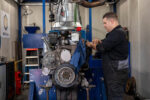
The power test (dyno test)
With the power test, we determine whether the engine in use still delivers the same power as the factory specifications. This is a good indication of whether the engine is still suitable for installation.
A Liebherr engine is on average set at 2000 to 2100 revolutions per minute. At the start, we let the engine run freely at this speed. Then we gradually increase the load on the engine with the dyno (electronic brake) that we have installed. The engine will need to take in increasing amounts of fuel to keep running at 2000 revolutions under the rising load.
At a certain point, the load will become so high that the speed begins to drop. The engine power will continue to increase up to a certain point. For Liebherr engines, this is around 1800 revolutions per minute. If the speed drops further, the power will also decrease. Usually, we stop at 1700 to 1600 revolutions because we have already measured the peak and the Liebherr engines do not operate in this speed range.
We measure these values
During testing, we monitor all measurable values. This allows us to accurately inform you about the condition of the engine. Consider values such as:
- Exhaust temperature
- Intake temperature
- Coolant temperature
- Oil temperature
- Fuel pressure
- Oil pressure
- Intake pressure
- RPM
How do I read the report?
The graph you see has two lines. You can see the engine’s power and torque at a certain number of revolutions. You should actually read this graph from right to left, because we start at idle at 2000 RPM. The more the dyno applies braking, the more the engine loses RPM.

Can every motor be tested?
Almost every Liebherr engine can be tested. The test bench is built to handle forces up to 7,000 nm. Because a test never runs at maximum power for longer than 1 minute, the dyno will not become too hot even under high loads.
How long do the measured values remain valid?
A test report is a snapshot. When the engine is used, the values will not remain the same. With normal use, an engine wears, and this affects the power the engine delivers.
Unique in the world: dyno test for used Liebherr engines
We supply only reliable used Liebherr parts. That is why we offer this service, which is unique for second-hand Liebherr engines. All our engines come with a comprehensive test report. This ensures you of quality and you always receive at least a one-month warranty on the engine.
Would you like to know more about our tests? Contact our specialist or check our webshop for our complete range of used engines.